Teamfight Manager 2
Teamfight Manager 2 is an esports management simulation that puts you behind the desk of a professional gaming organization, where drafting champions, recruiting talented players, designing team tactics, and adapting to a changing competitive meta all matter. Developed and published by Team Samoyed, the sequel expands the original formula with deeper strategy, a new MOBA-style match format, detailed player behavior, online competition, and a larger champion roster. Instead of controlling every attack directly, you prepare the team, study the opposition, shape individual instructions, and hope your decisions survive contact with five unpredictable virtual athletes. The result blends sports management, auto battler strategy, pick and ban decisions, transfer negotiations, pixel graphics, and real-time esports drama into one addictive coaching experience. Released in Early Access on May 25, 2026, Teamfight Manager 2 includes its main gameplay loop while leaving room for balance changes, new champions, management features, and community-driven improvements.
Become The Coach Behind The Screen
The central fantasy is simple: you are not the star player, you are the person responsible for creating the conditions that let stars succeed. Every season asks you to assemble a competitive roster, examine player strengths, prepare strategies, and make decisions that affect the entire organization.
A winning teamfight is not only a flashy animation. It may be the result of a smart transfer, a well-planned draft, a carefully assigned role, or a personal tactic created to exploit an opponent’s habits. Losses feel personal too, especially when a brilliant plan collapses because the wrong player chases a kill at the worst possible moment.
A New MOBA-Style Match Format
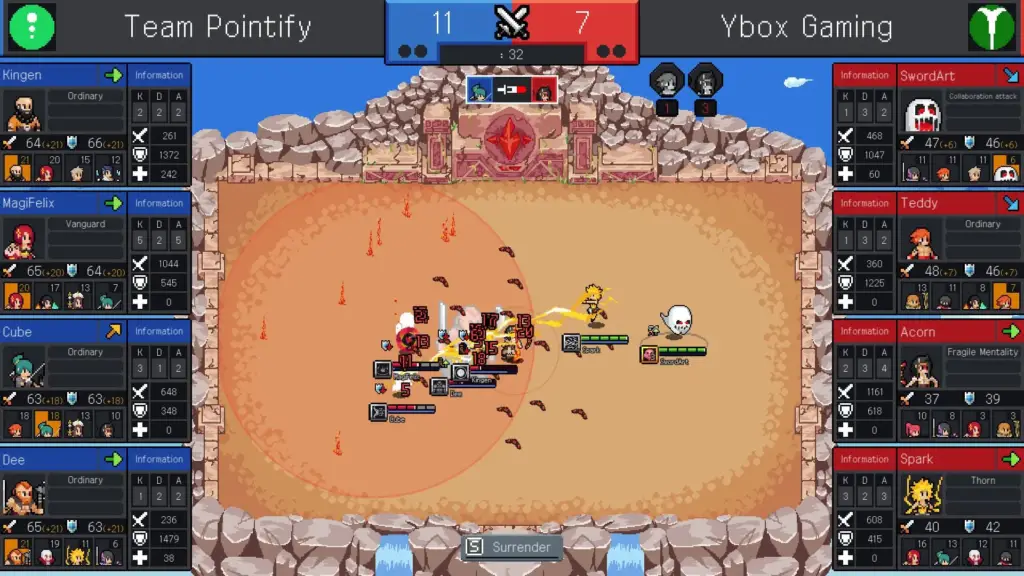
One of the biggest changes in Teamfight Manager 2 is its expanded MOBA-inspired battlefield. Teams operate across top, jungle, mid, bot, and support positions while trying to destroy the opposing Relic. This structure adds lane matchups, rotations, objective pressure, role balance, and coordinated movement. Managers can also set broader Team Tactics and focused Personal Tactics, creating more ways to influence how the squad behaves.
The matches are enjoyable to watch, but they also provide information to analyze. A weak laning phase may reveal a poor matchup. A failed objective contest can expose bad timing. A strong player might dominate mechanically while still making reckless decisions. Every game becomes both entertainment and evidence for the next coaching choice.
Drafting Champions And Reading The Meta
Champion selection remains at the heart of the experience. The sequel combines returning characters with dozens of new champions, and several existing abilities have changed. Familiar strategies cannot always be copied without thought. Players need to consider role coverage, counters, damage profiles, crowd control, and the champions their roster can use effectively.
A clever draft can compensate for weaker talent, while a careless selection phase can waste an expensive lineup. Studying opponents, tracking successful combinations, and keeping up with balance changes can create an advantage before the match begins. Few moments feel better than watching an unusual composition work exactly as planned.
Players Feel More Like Individuals
Recruitment is more than purchasing the highest numbers available. In Teamfight Manager 2, player attributes influence AI decisions and control rather than directly increasing basic damage values. This helps virtual professionals behave differently. One athlete may show excellent judgment, another may rely on aggression, and a promising rookie might need time before becoming dependable.
Managers can monitor Solo Rank and observe other teams before entering transfer negotiations. Finding an undervalued player and signing them at a reasonable cost can be as satisfying as winning a final. A substitute can become a starter, a risky signing can develop into a superstar, and an expensive veteran can fail to fit the system.
Deathmatch Brings Faster Action
For players who miss the compact battles of the first Teamfight Manager, Deathmatch offers a direct alternative. Games take place on a smaller map without minions, objectives, recalls, or healing. Victory goes to the team with the most kills when the timer ends, and match sizes can range from 2 versus 2 to 5 versus 5.
With macro play and laning removed, champion synergy and raw combat behavior take center stage. It is ideal for quick experiments, explosive matches, and testing whether a lineup can actually fight.
Steam Workshop And Long-Term Variety
Steam Workshop support lets the community create champions, teams, players, maps, and tournaments. That could become one of the game’s strongest long-term features because management simulations thrive on fresh leagues, custom rosters, unusual rules, and fan-made competitive worlds.
The Early Access structure means the game is still evolving. Team Samoyed says the current version contains the core champion roster, team management systems, and online league mode. Future development is expected to focus on refinement, balancing, bug fixes, additional champions, and possible management features. The developer currently anticipates roughly one to two years in Early Access, although that timeline may change.