 Half Sword
Half Sword
5 Mods 0 Tools 0 Articles 150 Downloads
Half Sword is a physics-based medieval combat simulator that trades automatic attack animations and simple button combinations for direct, unpredictable control over every swing, block, stumble, and desperate attempt to stay alive. Developed by Half Sword Games and published by Game Seer Publishing, the game places players in violent tournaments inspired by 15th-century Europe, where historically grounded swords, axes, polearms, armor, shields, and improvised weapons react through a detailed physical simulation. You begin as an ordinary commoner with little equipment or reputation, then enter increasingly dangerous fights to earn money, gain renown, improve your gear, and work toward the status of a fully equipped knight. Because the mouse controls weapon movement, combat feels less like selecting an attack and more like physically guiding a heavy object through space. A clean strike can end a duel in seconds, but poor balance, awkward positioning, or an overconfident swing can leave your character falling into the dirt beside the opponent. That mixture of realism, dark humor, historical equipment, graphic violence, ragdoll movement, and skill-based swordplay gives Half Sword an identity that is difficult to confuse with a traditional action game.
Control The Weapon With Your Mouse
The unusual control system is the feature that defines Half Sword.
Moving the mouse influences the direction and motion of your weapon. Instead of pressing one key for a light attack and another for a heavy attack, you create strikes by guiding the weapon through an arc. You can attempt overhead blows, side swings, thrusts, defensive movements, and awkward emergency attacks when an opponent gets too close.
The system can feel clumsy during the first few matches. That is part of the learning process. A player who swings wildly may generate power, but the attack can miss, hit armor at a poor angle, or pull the character off balance.
Better control comes from smaller movements, careful timing, and awareness of where the weapon is positioned before beginning the next action.
Physics Make Every Fight Unpredictable
Combat in Half Sword is governed by physical interaction rather than perfectly synchronized choreography.
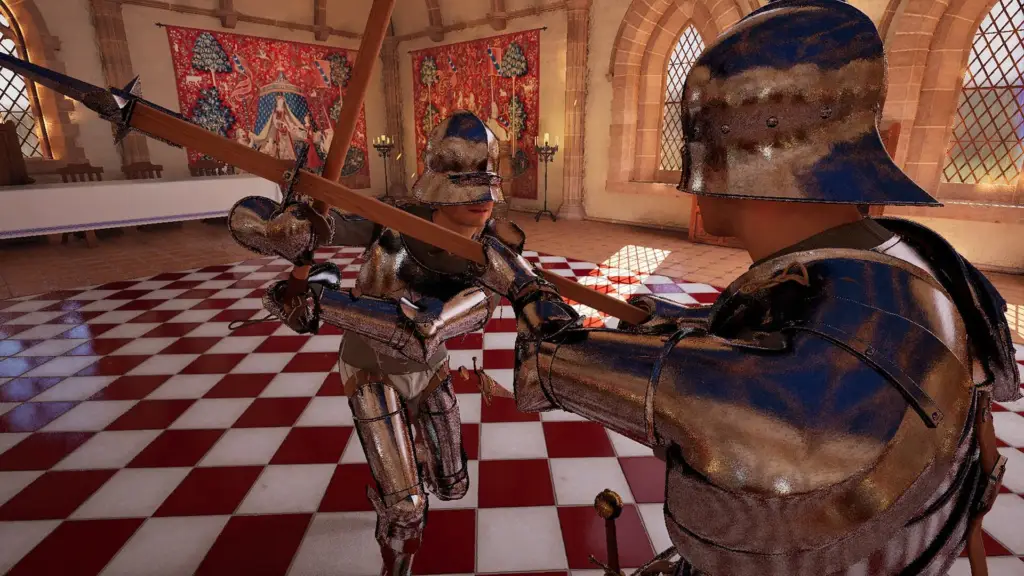
Weapons collide with armor, bodies, shields, other weapons, and the environment. Characters can lose their balance, fall over, become trapped beneath opponents, or struggle to stand while a fight continues around them.
This creates battles that can be tense and absurd at the same time. Two heavily armored fighters may exchange careful blows for several minutes. Another match may end immediately because one person trips, drops a weapon, or takes a lucky hit before establishing a proper stance.
The unpredictability keeps repeated fights from feeling identical. Even when the same equipment is used, differences in angle, movement, and impact can produce a completely different result.
Fight Your Way From Commoner To Knight
Progression gives the arena battles a larger purpose.
You begin near the bottom of the medieval social and martial ladder. Early equipment can be limited, and your opponents may look only slightly more prepared than you are. Winning fights builds reputation and provides wealth that can be invested in better weapons and protection.
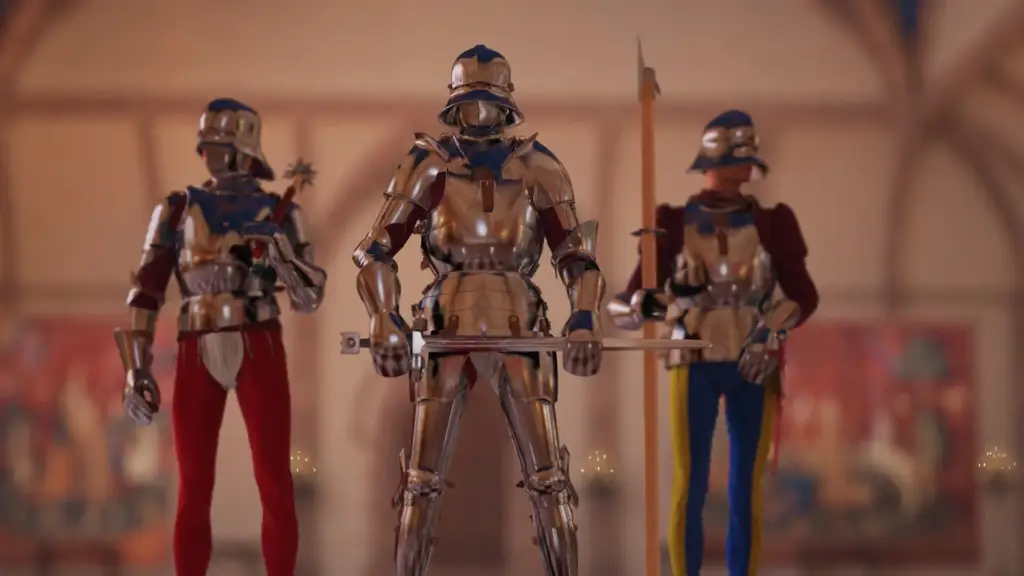
As the journey continues, basic clothing and crude tools give way to helmets, shields, stronger weapons, and increasingly complete suits of armor.
The change is not purely visual. Better equipment alters how you approach combat. Heavy armor can protect against certain strikes, but it may also affect movement and recovery. A long weapon offers reach, yet it becomes awkward when an enemy closes the distance.
Becoming a knight is therefore not only a matter of collecting expensive gear. You must learn how to use each new advantage without creating a different weakness.
Historical Weapons And Armor
Half Sword draws heavily from arms and armor associated with 15th-century Europe.
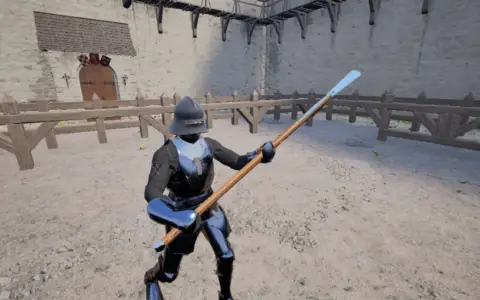
Players can encounter swords, daggers, polearms, axes, blunt weapons, shields, helmets, and layered defensive equipment. The game presents armor as part of the combat system rather than a simple number added to a character sheet.
A sharp edge may be devastating against an unprotected target but less useful against a solid armored surface. Blunt force can become more valuable when fighting heavily protected opponents. Thrusting attacks may help target gaps, while longer weapons can control distance in open space.
This encourages players to consider what they are holding and what the opponent is wearing. The most dramatic weapon is not always the most practical choice.
Combat Informed By Real Martial Practice
The developers built the fighting system with feedback and knowledge from Historical European Martial Arts practitioners and sword fencers.
That influence can be seen in the importance of distance, weapon position, timing, and controlled movement. The game does not turn every real technique into a strict command that must be memorized. Instead, it attempts to create physical conditions where sensible martial decisions have value.
Maintaining reach matters. Protecting the head matters. Allowing a heavy weapon to travel too far past its target can leave an opening.
The result is not a formal training simulator, but it rewards more thoughtful behavior than simply spinning the mouse as quickly as possible.
One-On-One Duels And Group Brawls
Different types of battles demand different strategies.
A duel allows you to focus entirely on one opponent. You can study their weapon, watch their movement, test their reactions, and search for a safe moment to attack.
Group fights are much less orderly.
In a brawl, danger can arrive from several directions. A player who spends too long fighting one enemy may be struck by another. Fallen bodies and dropped weapons can clutter the area. Fighters may collide with each other, and a strong position can become chaotic without warning.
Survival often requires movement and awareness rather than technical perfection. Sometimes the smartest decision is to step away and let several opponents weaken each other first.
Wealth, Renown, And Equipment
Winning is valuable because success supports future progress.
Renown represents your growing status in the arena. Wealth allows you to obtain equipment that better matches your preferred approach. Players can also bet on their own performance, creating an opportunity to increase earnings while adding more risk to a fight.
You may choose a mobile style built around lighter equipment and careful spacing. Another approach may favor heavy protection and a weapon capable of delivering powerful impacts.
There is no perfect setup for every encounter. Equipment should support how you fight, the opponents you expect to face, and the amount of control you currently have over the physics system.
Expensive gear cannot completely protect a careless fighter.
Death Has Real Consequences
Death in Half Sword is final for the current run.
That rule changes the mood of every tournament. A character carrying valuable equipment and significant progress has more to lose than a new commoner entering an early match.
The possibility of permanent defeat can make cautious play feel sensible. It also creates memorable moments when a well-developed fighter is suddenly eliminated by a mistake that seemed harmless a few seconds earlier.
The game wants victories to feel earned, but it also accepts that medieval combat can be unfair, sudden, and brutally short.
A Very Graphic Medieval Combat Game
Half Sword is designed for mature players and contains extensive blood, gore, dismemberment, exposed anatomy, and realistic physical damage.
The violence is not limited to a small visual effect shown after a finishing move. Damage is connected to weapons, impact locations, armor, and the physical state of the fighters. Serious injuries can dramatically change the direction of a battle.
This level of detail supports the game’s harsh interpretation of medieval combat, but it will not suit everyone. Players who are uncomfortable with graphic violence should approach the game carefully or avoid it.
The exaggerated physics can sometimes make a scene darkly funny, yet the visual presentation remains intentionally intense.
Early Access Development
Half Sword is currently an Early Access game, which means its mechanics, balance, animations, performance, and available content may continue to change.
The developers have indicated that community feedback is part of the development process. Planned areas of expansion include additional maps, improved gore systems, forge mechanics, heraldry customization, and further work on the Abyss.
Players should expect occasional rough edges and adjustments. A control technique that works well in one version may feel different after changes to animation, locomotion, damage, or weapon handling.
Anyone considering the game should judge the available Early Access build as a work in progress rather than a finished package.
Visual Style And Medieval Atmosphere
The arenas and equipment create a grounded historical tone, but the unpredictable body physics prevent the presentation from becoming overly serious.
Characters can look intimidating while fully armored, then immediately collapse into an undignified heap after missing a swing. That contrast between detailed equipment and physical chaos gives the game much of its personality.
The sound of metal impacts, heavy footsteps, weapons scraping against armor, and fighters struggling for position helps make each clash feel dangerous.
There is little need for a dramatic cinematic sequence when the combat itself generates stories.
System Requirements And Platform
Half Sword is available for Windows PC through Steam. The official minimum specifications list Windows 10 64-bit, 8 GB of RAM, a GTX 1060 6 GB or RX 580-class graphics card, and 15 GB of available storage. An SSD is recommended.
The game is single-player and does not currently list VR support.
Because physics simulation can place a significant load on a system, performance may vary during crowded fights or scenes containing several active objects and characters.
Latest Mods
View All → Half Sword 
 Half Sword
  Half Sword
  Half Sword